

Introduction
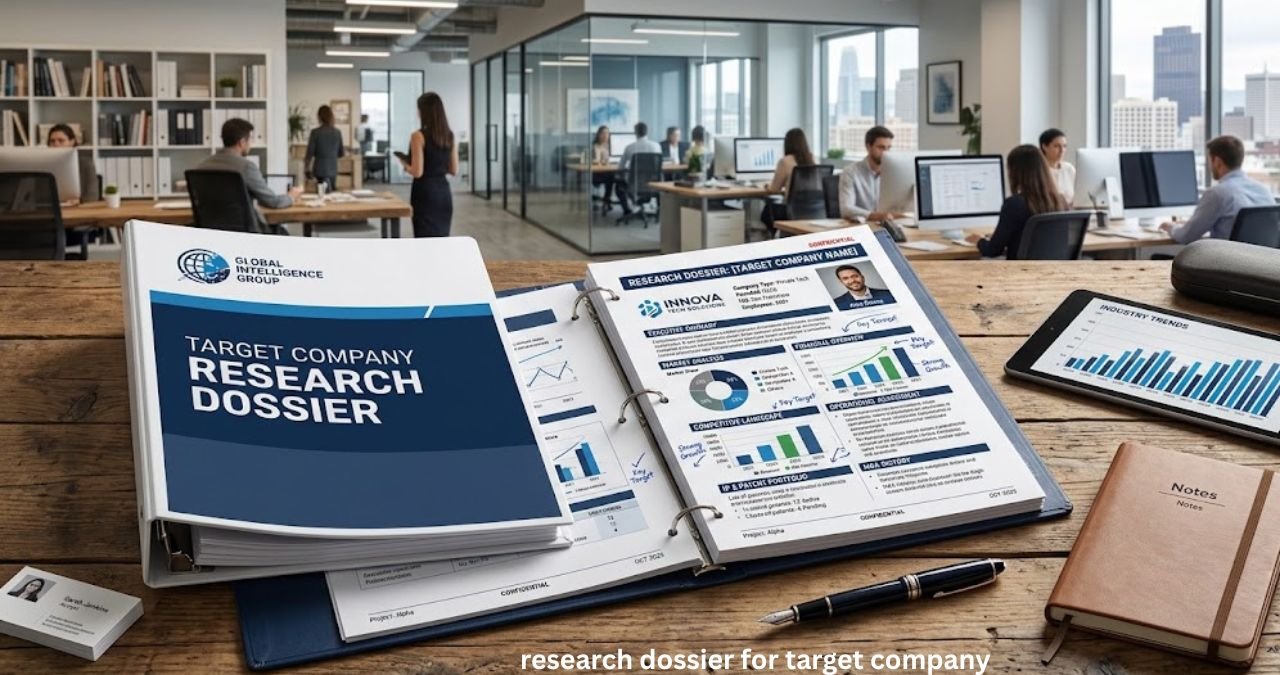
A research dossier for target company is a structured collection of information about a business that helps individuals and organizations understand its background, operations, reputation, financial position, market presence, and potential risks. It brings relevant information from different sources into one organized document, making company research easier to review and use.
Businesses prepare company research dossiers for several reasons, including evaluating potential partners, identifying competitors, assessing suppliers, researching acquisition opportunities, and preparing for important business meetings. Instead of relying on scattered search results, a well-prepared dossier provides a clearer picture of the company and the evidence supporting that picture.
This guide explains what a company research dossier includes, how to prepare one, which sources to consult, what tools can help, and how to distinguish verified facts from assumptions. It also covers common mistakes and practical ways to make the final report useful for decision-making.
What Is a Research Dossier for a Target Company?
A research dossier for a target company is a detailed business research document that combines relevant information about a specific organization. The term target company can refer to a prospective client, competitor, supplier, investment opportunity, acquisition candidate, or potential business partner.
The dossier is designed to answer practical questions. Who owns the company? What products or services does it provide? Who are its customers? How does it compete in the market? Are there any legal, operational, or reputational concerns that require further investigation?
The depth of the research depends on the intended purpose. A sales team preparing to approach a potential customer may focus on the company’s services, leadership, business priorities, and public announcements. An acquisition team may need much more extensive research into financial statements, ownership, liabilities, contracts, and regulatory obligations.
A useful dossier is not simply a collection of copied web pages. It organizes evidence, explains why the information matters, identifies unanswered questions, and helps readers decide what to investigate next.
Why Is a Company Research Dossier Important?
Company research can reduce uncertainty before a business decision. Although no report can guarantee a successful partnership or investment, organized research helps decision-makers identify opportunities and recognize warning signs earlier.
Better business decisions
A dossier provides a consolidated view of the company rather than forcing readers to switch between multiple websites and documents. It can help management compare alternatives, prepare questions, and decide whether further investigation is justified.
Stronger sales and marketing preparation
Sales professionals can use company research to understand a prospect’s business model, industry, customers, and publicly announced priorities. This information supports more relevant outreach than a generic sales message.
For example, a company selling cybersecurity services might investigate a prospective customer’s industry, published security requirements, technology environment, and recent expansion announcements. The findings can help the sales team prepare a relevant conversation without making unsupported assumptions about the customer’s internal systems.
More informed risk assessment
Research may reveal issues requiring additional checks, such as inconsistent company information, unresolved public regulatory matters, unclear ownership, or significant dependence on a small number of products.
These observations should be treated as indicators for further investigation, not automatic proof of wrongdoing or business failure.
Competitive intelligence
A company dossier can help businesses understand competitors’ product offerings, public positioning, geographic reach, partnerships, and marketing strategies. This information can support market planning and identify areas where a business may differentiate itself.
What Information Should a Company Research Dossier Include?
The sections in a dossier should reflect the purpose of the research. However, several categories are useful in most business investigations.
Company overview
Begin with the company’s basic identity and business activities.
Include:
- Official company name and known trading names.
- Headquarters and publicly documented operating locations.
- Official website and relevant contact information.
- Year of establishment, where reliably documented.
- Main products, services, and business activities.
- Industries and geographic markets served.
- Legal entity type and registration details, where available.
Verify important details through official company materials and relevant business registries. A website’s description of itself is useful background, but it should not automatically be treated as independent confirmation of every claim.
Ownership and leadership
Identify the people and entities responsible for the company’s direction and ownership, to the extent this information is publicly available and relevant.
Potential research subjects include founders, executives, directors, parent companies, subsidiaries, and publicly disclosed beneficial owners.
Leadership biographies can help establish professional experience and organizational responsibilities. However, a person’s presence on a company website does not independently verify every claimed qualification.
For private companies, ownership information may be limited. Record those limitations rather than assuming that missing information indicates a problem.
Products, services, and business model
Explain what the company sells, who its customers are, and how it generates revenue when that information can be established.
A useful review examines:
- Main products and service categories.
- Customer segments and industries served.
- Pricing information, if publicly available.
- Distribution and sales channels.
- Subscription, licensing, or transaction-based revenue models.
- Publicly announced product developments.
The objective is to understand how the organization creates value and whether its offering is relevant to the researcher’s goals.
Financial and operational information
Financial research can be essential when evaluating a supplier, investor, acquisition candidate, or major business partner.
Depending on the company and jurisdiction, useful documents may include annual reports, audited financial statements, regulatory filings, credit reports obtained through authorized channels, and official announcements.
For listed companies, published reports may provide information about revenue, operating expenses, profitability, debt, cash flow, and business segments. Private companies may disclose considerably less.
Avoid estimating financial performance from website traffic, social media followers, or employee counts alone. These indicators may provide context, but they do not establish revenue or profitability.
Market position and competitors
A dossier should explain the market in which the target company operates.
Research the company’s principal competitors, product differences, target customers, geographic reach, and publicly documented market developments. Industry reports and competitors’ official materials can help build context.
Market-share claims require particular care. Check how the figure was calculated, which geographic area and period it covers, and whether the source explains its methodology.
Reputation and risk indicators
Review credible public information about the company’s reputation and potential exposure to risk.
Relevant areas may include customer feedback, product recalls, public litigation, regulatory enforcement, cybersecurity disclosures, and significant service disruptions.
Separate verified events from allegations, commentary, and personal opinions. For legal matters, confirm the jurisdiction, status, relevant dates, and outcome before describing a case as resolved or ongoing.
How to Research a Target Company Step by Step
A repeatable process makes company research more consistent and easier to verify.
Define the research objective
Start by identifying the decision the dossier should support. A report prepared for a sales meeting will look different from one prepared for an acquisition review.
Write down the main questions before collecting information. This prevents the research from becoming an unfocused collection of facts.
For example, a supplier assessment may ask whether the business is legally registered, offers the required products, has suitable operational capacity, and meets relevant compliance requirements.
Identify reliable information sources
Use a combination of primary and secondary sources.
Primary sources include official company reports, government registries, regulatory filings, court records, and company announcements. Secondary sources include established news publications, industry analyses, and independent research reports.
Useful starting points include:
- Official company website and investor relations pages.
- Relevant government business registries.
- Securities regulators and stock-exchange filings.
- Intellectual property databases.
- Reputable industry publications.
- Official court or regulatory records, where accessible.
The correct source depends on the company’s location, legal structure, industry, and research purpose.
Collect and organize evidence
Record each relevant finding alongside its source, publication date, retrieval date, and verification status.
A structured spreadsheet can be useful for collecting basic information before transferring the key findings into a written report.
For example, an ownership claim should be linked to an official filing or another reliable source, rather than supported only by an unsourced company profile.
Verify important claims
research dossier for target company Cross-check information that could materially affect a business decision. Company names, registration numbers, financial figures, ownership details, and legal developments deserve particular attention.
When sources disagree, document the discrepancy and investigate whether it results from different reporting periods, legal entities, definitions, or outdated information.
Do not force conflicting evidence into a single conclusion when the available information does not support one.
Analyze the findings
The dossier should explain what the evidence means for the research objective.
A company with a strong product offering but limited public financial disclosure may be attractive for a preliminary sales conversation but require additional checks before a major financial commitment.
This distinction between evidence and interpretation helps readers avoid treating reasonable hypotheses as established facts.
Prepare the final report
Organize the findings into sections that readers can scan quickly. Lead with an executive summary, followed by the company profile, ownership, business model, market position, risks, and recommended next steps.
Include citations or source references near the relevant claims. Finish with unanswered questions and a clear explanation of the research limitations.
Tools and Sources for Company Research
Different tools serve different research needs. No single platform provides a complete picture of every business.
| Research tool or source | Main purpose | Important limitation |
|---|---|---|
| Official company website | Products, services, leadership, announcements | Information is often self-reported |
| Government business registry | Legal registration and filed records | Coverage and access vary by jurisdiction |
| Securities regulator filings | Public-company financial and corporate disclosures | Usually limited to regulated entities and required filings |
| Public professional profiles and organizational context | Profiles may be incomplete or outdated | |
| Industry reports | Market trends and competitive context | Methodologies and coverage vary |
| Reputable news publications | Public developments and independent reporting | Reports may require corroboration |
| Intellectual property databases | Registered trademarks and patent records | A search does not necessarily reveal all relevant rights |
| Financial research platforms | Financial statements, estimates, and company comparisons | Data access, accuracy, and coverage vary |
Tools such as OpenCorporates and Crunchbase may help identify corporate records, funding announcements, or business relationships. Their coverage should be checked against official documents before important conclusions are drawn.
For public companies in the United States, the SEC EDGAR database is a valuable source of regulatory filings. Other countries have their own company registries and securities regulators.
Example: What a Target Company Dossier Looks Like
Consider a hypothetical software business being evaluated as a potential technology supplier. The example below illustrates how findings can be organized without inventing facts about a real organization.
| Dossier section | Information to document | Business question answered |
|---|---|---|
| Company profile | Legal name, website, registration | Is this the correct business entity? |
| Leadership | Publicly documented executives and directors | Who is responsible for the organization? |
| Products | Software offerings and supported services | Does the company meet the technical requirements? |
| Financial position | Available accounts and verified disclosures | What financial information is available? |
| Market position | Competitors and target customers | How does the offering compare with alternatives? |
| Risk review | Documented regulatory, operational, and reputational issues | What requires further investigation? |
| Recommendation | Findings, gaps, and next steps | Should the evaluation continue? |
The final recommendation might be to proceed to a technical demonstration, request financial documents, or conduct additional compliance checks. The decision should follow the evidence rather than a predetermined assumption that the company is suitable or unsuitable.
Benefits and Limitations of Company Research Dossiers
A well-prepared dossier offers several practical advantages, but readers should understand what it can and cannot establish.
Key benefits
Centralized information: Relevant findings and sources are collected in one place.
Improved preparation: Teams can enter meetings with a clearer understanding of a company’s products, priorities, and market.
Better comparison: A consistent template makes it easier to evaluate multiple suppliers or competitors against the same criteria.
More traceable decisions: Source references help reviewers understand where conclusions originated and whether further verification is necessary.
Common limitations
Incomplete disclosure: Private companies may not publish detailed financial or operational information.
Outdated information: Leadership, ownership, products, and business conditions can change after a report is prepared.
Source bias: Company announcements, customer reviews, and third-party databases each have their own limitations.
False confidence: A detailed report can still contain errors if its sources are unreliable or its conclusions go beyond the available evidence.
Privacy and legal concerns: Research should use lawful sources and respect applicable privacy, data protection, confidentiality, and access restrictions.
A dossier should therefore be treated as a decision-support document, not a guarantee of future performance or a substitute for professional legal, financial, or technical due diligence.
Common Mistakes to Avoid
Several mistakes can undermine otherwise useful company research.
- Relying on one source: Important claims should be checked against independent or authoritative evidence when possible.
- Confusing similarly named companies: Confirm legal names, registration numbers, domains, and jurisdictions.
- Treating allegations as facts: Use precise language and verify the status of reported disputes.
- Ignoring publication dates: Historical information may no longer describe the company’s current position.
- Mixing facts with opinions: Label analysis and assumptions clearly.
- Collecting irrelevant information: Focus on evidence that supports the research objective.
- Overlooking missing data: State when information could not be verified and explain why the gap matters.
- Using unauthorized information: Do not bypass access controls or collect confidential personal or commercial information without a lawful basis.
A strong dossier does not need to contain every available detail. It needs to contain the right details, supported by reliable evidence and organized around a specific decision.
How to Keep a Company Research Dossier Updated
A dossier is most useful when its information remains relevant. Establish a review schedule that reflects the importance of the business relationship and how quickly its circumstances may change.
For a routine sales prospect, updating the dossier before a major meeting may be sufficient. A critical supplier or acquisition candidate may require more frequent checks and formal monitoring.
Record the date of the latest review and flag information that needs confirmation. Update material changes in ownership, leadership, regulatory status, financial disclosures, and product availability when reliable evidence becomes available.
Version control also matters. Preserve earlier versions when decisions depend on the history of a company’s disclosures or the development of a risk assessment. Restrict access to sensitive business documents and follow the organization’s retention policies.
Frequently Asked Questions
What is the main purpose of a research dossier for a target company?
Its main purpose is to organize reliable information about a business so that a person or organization can make a more informed decision. Common uses include supplier evaluation, sales preparation, competitor research, investment analysis, and acquisition screening.
How long should a company research dossier be?
There is no universal length. A short prospect brief may need only a few pages, while an acquisition or high-risk supplier review may require extensive supporting documentation. The report should be long enough to answer the relevant questions without adding unnecessary information.
What is the difference between a company profile and a research dossier?
A company profile generally summarizes a business’s identity, products, and activities. A research dossier goes further by examining ownership, market position, financial disclosures, risks, evidence quality, and unanswered questions relevant to a particular decision.
Which sources are most reliable for company research?
Official registries, regulatory filings, audited financial statements, court records, and original company disclosures are valuable starting points. Reliability depends on the specific claim, so independent reporting and corroboration may also be necessary.
Can a research dossier be created for a private company?
Yes. Researchers can use available company websites, business registries, public announcements, professional profiles, industry publications, and authorized business information services. However, private-company financial and ownership details may be unavailable or restricted.
Should a company research dossier include financial information?
When financial stability matters to the decision, it should include relevant verified financial information. This may cover published revenue, profitability, debt, cash flow, or filed accounts. If these details are unavailable, the dossier should explicitly identify the limitation instead of inventing estimates.
How often should a company dossier be updated?
The review schedule depends on the purpose. Update it before important decisions and whenever material new information becomes available. High-risk business relationships may require more frequent monitoring than preliminary sales research.
Can AI tools help prepare a company research dossier?
AI tools can help organize notes, summarize supplied documents, draft sections, compare findings, and identify questions that need further investigation. However, they can produce inaccurate statements or misunderstand sources. Verify important claims against original evidence, protect confidential information, and do not treat generated content as independent proof.
Conclusion
A research dossier for a target company provides a structured way to understand a business before making an important commercial, strategic, or financial decision. Its value comes from the quality of its sources, the relevance of its findings, and the care taken to distinguish verified information from interpretation.
Start with a clear objective, collect evidence from reliable sources, verify material claims, and organize the results into a report that answers practical questions. Include uncertainties and research gaps rather than hiding them. With a consistent process and regular updates, a company dossier becomes a useful foundation for informed decisions and more effective business planning.
