

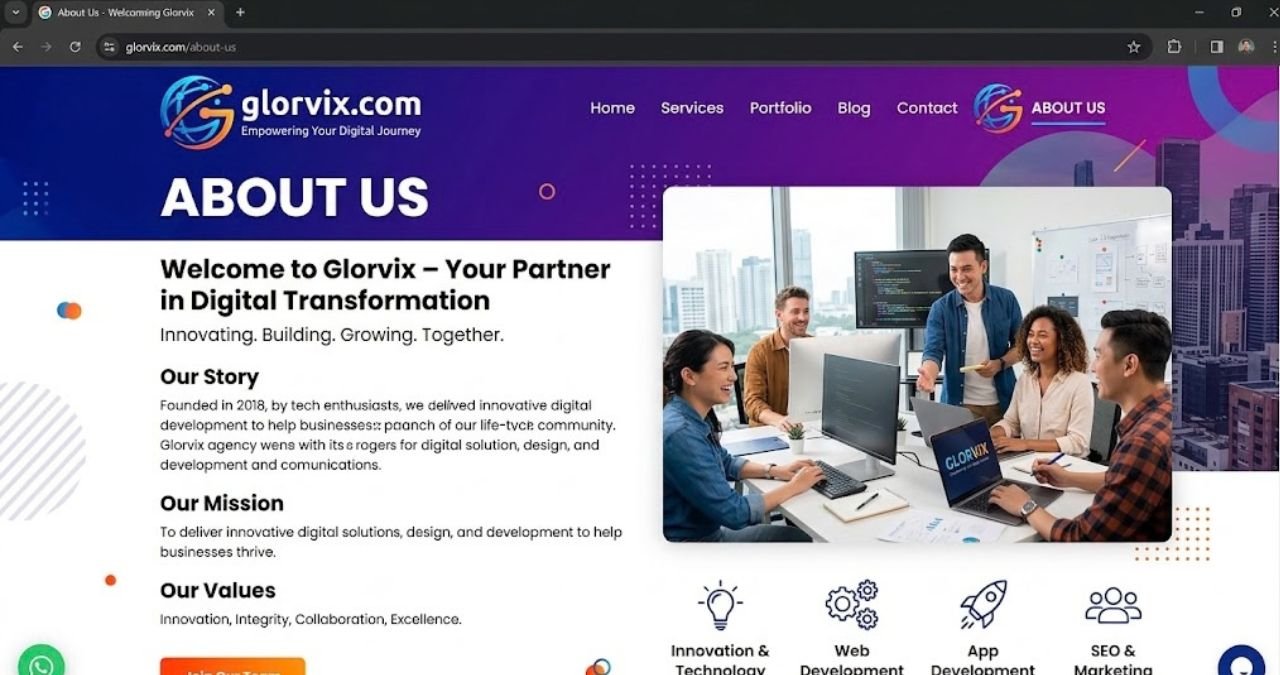
Searching for glorvix com about us usually means you want to understand who operates Glorvix, what the website is designed to provide, and whether the information published there is worth relying on. An About Us page can be useful for answering these questions, but it should be considered alongside the site’s content, contact information, privacy policies, and other trust signals.
This guide explains what readers should look for when evaluating an About Us page associated with Glorvix. Because website ownership, editorial policies, and features can change, readers should verify current information directly on the website rather than relying on assumptions about the platform.
The goal is not simply to describe an About Us page. It is to show you how to assess the identity, purpose, content, transparency, and usefulness of a technology-focused website.
What Does Glorvix Com About Us Mean?
The phrase glorvix com about us has a primarily navigational and informational search intent.
Someone searching this phrase may already know the Glorvix name and want to find its About Us information. They may be looking for details such as:
- What Glorvix is
- What type of website it operates
- Who the intended audience is
- What subjects it covers
- Who is behind the website
- How the site approaches its content
- How readers can contact the organization
- Whether the website provides enough information to establish trust
An About Us page is therefore more than a short company description. For an online publication or technology website, it can provide important context about the site’s purpose and editorial identity.
Why an About Us Page Matters
An About Us page gives visitors a way to understand a website beyond individual articles.
For example, a technology article may explain a particular website, application, digital service, or online trend. The article tells you about the subject, while the About Us page can explain who is publishing that information and what the publication is trying to accomplish.
A useful About Us page normally answers basic questions without requiring visitors to search through several unrelated pages.
Website identity
The first thing a reader should be able to establish is the site’s identity.
Look for a clear explanation of the website’s name, purpose, and general area of coverage. If the site presents itself as a technology publication, its description should make that purpose understandable.
Editorial purpose
A good publication should communicate what kind of information it aims to provide.
This might include technology explainers, online platform guides, software information, digital trends, tutorials, or other related subjects. The exact focus should come from the website’s own current description rather than assumptions.
Contact information
A legitimate-looking publication should make it reasonably clear how readers can contact the organization or site administrators.
The contact method may be an email address, contact form, or dedicated Contact page. Contact information does not by itself prove that every claim on a website is accurate, but its absence can make it harder for readers to ask questions or report problems.
What Can Readers Learn From the Glorvix About Page?
When examining the Glorvix About Us information, focus on specific details rather than general promotional language.
A useful About page should ideally explain several elements of the publication.
| Information to check | Why it matters |
|---|---|
| Website purpose | Helps readers understand the site’s main objective |
| Main topics | Shows what subjects the publication focuses on |
| Intended audience | Explains who the content is written for |
| Editorial approach | Gives context about how content is produced |
| Contact details | Provides a way to communicate with the site |
| Ownership or organization details | Can provide additional transparency |
| Policies | Helps readers understand privacy and website practices |
Not every website will provide all of these details. However, the more clearly a publication explains its identity and operating purpose, the easier it is for visitors to understand what they are reading.
How to Evaluate Glorvix as a Technology Website
Finding an About Us page is only the first step. If your goal is to determine whether Glorvix is useful or trustworthy, examine the wider website.
Check the content categories
Start by looking at the site’s main categories and recent articles.
Ask whether the published material has a consistent subject focus. A technology site may cover websites, software, apps, digital services, online tools, cybersecurity, artificial intelligence, gadgets, or other technology-related subjects.
The important point is consistency between the site’s stated purpose and the material it actually publishes.
Examine individual articles
Open several recent articles rather than judging the entire site from one page.
Look for:
- Clear explanations
- Specific examples
- Accurate terminology
- Helpful headings
- Author information where appropriate
- Sources for claims that require verification
- Updated information when the topic changes frequently
- Original explanations rather than repetitive text
A technology article can look professional while still providing limited practical value. Reading several pages gives you a better understanding of the site’s overall editorial quality.
Look for dates and updates
Technology information can become outdated quickly.
Software interfaces change. Websites redesign their services. Pricing changes. Features are added or removed. Company policies can also change.
For that reason, publication dates and update information can be particularly useful when evaluating technology-related content.
An old article is not automatically incorrect, but readers should be more cautious when the subject depends on current features or policies.
How an About Us Page Supports Website Transparency
Transparency is especially useful when a website publishes information that readers may use to make decisions.
For example, suppose an article explains how an online platform works. A reader may naturally want to know who published the explanation and what editorial purpose the website has.
An About Us page can provide that context.
However, readers should avoid treating an About page as automatic proof of accuracy. Statements about a website should still be considered alongside its actual content and other available information.
This distinction is important:
Identity information explains who a website says it is.
Content quality concerns how accurately and usefully the website communicates information.
Both matter, but they answer different questions.
How to Use Glorvix Information Responsibly
If you discover Glorvix through a search engine, start by identifying exactly what you need.
For example, you might be searching for information about a website or online service. Instead of accepting a short description immediately, compare the explanation with information available from the service’s own official channels.
This is particularly important for topics involving:
- Account security
- Payments
- Personal information
- Software downloads
- Business claims
- Legal requirements
- Product specifications
- Current policies
A technology publication can help you understand a topic, but primary sources are often more appropriate when you need confirmation of an official policy or technical specification.
Use multiple sources for important claims
For basic explanations, one useful article may be sufficient to introduce a subject.
For important decisions, however, compare information from several sources.
A practical approach is:
- Read the relevant Glorvix article.
- Identify the specific claims that matter.
- Check the official website or documentation connected to the subject.
- Compare dates and terminology.
- Look for information that may have changed since publication.
This approach reduces the chance of relying on outdated or incomplete information.
Benefits of Understanding the About Us Information
Learning about a website’s identity can provide several practical benefits.
It establishes context
An article makes more sense when you understand the publication behind it.
Knowing whether a site presents itself as a technology blog, digital publication, review website, or general information resource changes how you interpret its content.
It helps readers find relevant material
If Glorvix clearly explains its subject areas, visitors can decide whether the site is relevant to their interests.
Someone researching technology websites may want tutorials, explanations, or digital-service information, while another visitor may be looking for entirely different material.
It provides a starting point for verification
The About page can point readers toward other important areas of the website, such as Contact, Privacy Policy, editorial information, or other organizational details.
These pages can be examined together rather than individually.
Limitations to Keep in Mind
An About Us page has limitations.
The information may be brief, and some websites provide only a general description of their purpose. Others may update their content or branding without immediately updating every page.
There is also an important distinction between what a website claims about itself and what can independently be verified.
For that reason, avoid making strong assumptions based on an About page alone.
For example, an About page may describe a website as an authority on a particular topic. That statement should not automatically be interpreted as proof of expertise. Readers can examine authorship, article quality, citations, transparency, and other evidence.
Common Mistakes When Researching Glorvix
People searching for glorvix com about us can make a few simple mistakes.
Relying on one page
The About page is useful, but it should not be the only page you examine.
Check the homepage, articles, contact information, policies, and other relevant sections.
Assuming an About page guarantees accuracy
An About page describes a website’s identity and purpose. It does not independently verify every statement published on the site.
Ignoring publication dates
Technology information can change rapidly. Always check when an article was published or updated when current information matters.
Confusing an explanation with an official source
A third-party article may explain an online service very well, but official documentation remains important when you need authoritative information about features, rules, pricing, or account policies.
Who May Find Glorvix Useful?
The answer depends on the site’s current content and focus.
A visitor interested in technology-related information may find value in a publication that provides clear explanations of digital services, websites, software, and online trends.
It may also be useful for readers who want an introductory explanation before moving to a primary source.
Students, general internet users, technology enthusiasts, researchers, and people investigating unfamiliar online platforms can all benefit from explanatory technology content, provided they verify important claims where necessary.
Questions to Ask Before Trusting Information From Any Technology Website
Rather than asking only whether a website is trustworthy, use a more detailed checklist.
Who published the information?
Look for author or organization details where available.
When was it published?
Current subjects require current information.
Does the article explain its claims?
Useful articles generally provide enough context for readers to understand how conclusions were reached.
Can important claims be independently verified?
Compare critical information with primary sources.
Is the site transparent?
Look for About, Contact, Privacy, and other relevant information.
Does the article answer the actual question?
A page that repeats keywords without providing useful information is less helpful than a focused explanation.
Frequently Asked Questions
What is the search intent behind “glorvix com about us”?
The search is mainly navigational and informational. People are likely trying to locate or understand Glorvix’s About Us information, its purpose, identity, or website focus.
Is the Glorvix About Us page enough to evaluate the website?
No. It can provide useful background, but readers should also examine published articles, contact information, policies, authorship, dates, and other available evidence.
What should an About Us page contain?
A useful About page may explain the website’s purpose, topics, audience, editorial approach, organization, and ways to contact the site.
Why are publication dates important on technology websites?
Technology changes frequently. Features, interfaces, pricing, policies, and technical information can become outdated, so publication and update dates provide valuable context.
Should I use a technology blog as an official source?
That depends on the information you need. A technology publication can be useful for explanations and context, while official documentation or company websites are generally more appropriate for confirming official policies, features, specifications, and requirements.
How can I check whether information about Glorvix is current?
Visit the website directly and review its current About, Contact, homepage, and recent-content pages. For important claims, compare the information with relevant primary sources.
What other pages should I check besides About Us?
Useful pages may include Contact, Privacy Policy, Terms and Conditions, editorial information, author profiles, and recent articles. Together, these pages provide more context than an About page alone.
Conclusion
The search for glorvix com about us is essentially a request for greater context about the Glorvix website: what it is, what it aims to publish, and who stands behind the information.
The most useful way to investigate the site is to go beyond a single About Us page. Examine its current content, publication dates, contact information, policies, authorship, and consistency between its stated purpose and actual articles.
For technology-related research, also remember that websites and online services change frequently. Use explanatory articles to build understanding, then confirm important or time-sensitive claims through relevant primary sources.
That approach gives readers a clearer picture of Glorvix while avoiding assumptions that cannot be independently established.
